Wednesday, April 11, 2012

Kahani ek Shehar ki


Farida Batool’s ‘Kahani ek Shehar ki”, displayed at Rohtas 2 gallery, Lahore (from April 8th to 20th), presents us with her walk through the city streets, told in a first person singular voice ‘I’, as well as a collective ‘we’ or ‘they’ at the same time. She is both the native Lahori and the wandering tourist, placing a certain sense of displacement that can be appreciated on multiple levels and interpreted from multiple perspectives. The use of lenticular technique for printing these documents relies upon the active participation of the viewer and enables the viewer to become a silent witness as well as a participant with Batool in her meanderings through these streets. The technique involves layering two or more images to form a single image that has the ability to change/move/morph as the image is viewed from different angles. The movement of her body across these landscapes relates easily to the viewer’s own movement where you don’t have to adjust or dissociate what your eye is seeing from what you know your body is doing, i.e; walking. By design, they literally move each viewer’s body making the viewing experience completely subjective, as we animate her images and she animates our bodies.
The technique recalls, what has adorned the covers of musical records, children books, greeting cards and commercial advertisements throughout the marketing and communication mix, for decades now. What it does is, elicit our sense of wonder or makes one consider the possibilities of acquisition of space; space that the mind and the body occupies. Perhaps a clever critique of the consumer culture, also, blurring any borders between mainstream art and low/popular art.
What Batool is above all conscious of is the dialectical relationship between ‘what’ is said and ‘how’ it is said, regarding the latter as constitutive of the former. Something all art strives to achieve. Her form and content allow an interweaving of open-ended socio-cultural, political, economic, personal and aesthetic meanings, and the only form that can do so is one in which the form itself is the content.
Her ghost like presence, appearing and disappearing against graffitied walls, littered side walks, security barriers, street vendors, security guards, state buildings, cars, tongas, rickshaws and men, might not be the complete representation of the city but certainly provides the viewer with all the necessary clues, rather covertly presenting us, the city streets as a space where civil protection potentially breaks down, especially for women, since there is a particular absence of women in these public spaces which may or may not be a conscious decision but nevertheless significant.
These accidental yet staged scenes, suggest fragments from a narrative loaded with gender and identity politics, continuance of documentary style photography’s critical capabilities in the twenty-first century and for art objects to connect the personal with public. The presence of the camera (not physical of course) also points at the limitations of the medium of photography in embodying such an experience.
The work at large provides a fine balance between the creative endeavour of the artist and the creative projection of emotion and feeling on the part of the viewer, which Barthe refers to as the punctum. He writes, “the punctum is what I add to the photo and which nonetheless is there already”.


Sunday, April 1, 2012

THE LOOKING GLASS:


The widely accepted practice of women being the model and muse of male artists, has been a subject of much debate for most of the 20th century. However, women artists have used their work to disrupt this tradition and also the tradition of self-portraiture as a means for the male artist to assert ‘his’ identity, rarely have the women been presented as the subject of self-portraiture in the history of art.
Saira Sheikh’s Mirror Mirror on the Wall, an exhibition that opened last month at Rohtas 2 in Lahore, is a multi-layered project, creating a dialogue about the relationship between self-portraiture and mirror, perhaps casting doubt upon the seemingly similar characteristics between the two. The work is a radical departure from the conventions of art making in Pakistan, challenging, upsetting or perhaps reinforcing pre-conceived notions about art, for a bunch of reasons.
The gallery filled with drawings of the nude artist, is an investigation into the notion of ‘self-portraiture’, beyond the conventional portrait representation of the self. These unsigned drawings, sitting on easels or resting against the walls, are a combination of artist’s own rendition of the self in the mirror and drawings of six or seven other artists who were invited to the gallery a day before the opening of the show, where Sheikh modeled nude for a duration of six hours, as a living sculpture creating a hybrid of sculpture and performance. Performing the self-portrait is a way of coming into representation as both the subject and the object and like all performance-based art, it deals with aspects of control, the acquisition of an audience and subjecting them to the artist's "control" which involves another aspect of body art - endurance; both hers and the audience’s. The performance of actions is also a shift from the study of objects to a study of processes, in an attempt to articulate the self in everyday life and establishing a social identity based on everyday acts shaped through the practice of daily rituals.
This investigation into the nature of; self-representation, self-portraiture, autobiography, endurance, performance, objectification, perception, identity, socio-cultural acceptability, authorship, ownership, viewing/looking and artistic process, asks the viewer to think of art and the nature of artistic enterprise anew, particularly in this part of the world.
Sheikh is the creator, subject and the object of the work, both observer and the observed. This dichotomy is further highlighted when the viewer, upon entering the gallery is encountered by a mirror, on the façade of a small white cubicle, the size of a standard try-room perhaps. The reality of the looking glass is revealed to the viewer upon entering the cubicle from the back, which acts as a mirror from one side and a window from the other.  So upon entering the gallery the viewer watches him/herself, while from the inside of the cubicle the viewer watches the ‘others’ watching themselves, without the awareness of being watched, caught looking in on a private moment, overlapping public and private domains. The act of looking at the drawings is not any less voyeuristic than the experience of the cubicle, at once hallucinatory and distanced, suggesting the space of an imaginary world, with which the viewer is engaged privately but disconnectedly, hence the presence of one compliments the presence of the other, while also allowing the viewer to engage with the work more actively.
On one hand Sheikh takes control over her display by extending this invitation to be drawn, to reject subjection, an act of naked defiance or a sudden confrontation, that places the viewer in an equally vulnerable position, while on the other hand she stands motionless after extending that invitation, playing a submissive role, making herself vulnerable, reinforcing the prevalent ideas of female subjectivity, in a confrontation with the thin line between celebration of female sexuality and objectification of the female body, a rather tricky relationship to explore the many levels of self.
The exhibition despite being viewed within a controlled environment, by a small circle of seemingly like-minded people (plus some accidental viewers) who were invited to view the exhibit, is nevertheless going to act like a lightning rod (perhaps even by some of the readers of this review) for conflicting views of feminism, propriety, social responsibility, art-world economics, reputation-building and artistic license, which is a healthy dialogue, both in creative terms and for an ever expanding definition of art, as long as its constructive.

Sunday, March 11, 2012

Constructing meaning:


A two-person show, titled ‘Piece of Land’ opened at Rohtas2, Lahore, on March 8th 2012, featuring works by Saba Qizilbash and Saamia Vine. Why the two painters decided to show their works collaboratively, under the title ‘Piece of Land’ (which is also the title of 4 of Qizilbash’s paintings in the show and is perhaps only suitable for her body of work) is a question worth asking. The gallery filled with some 13 paintings in varying frames, forms and sizes was perhaps missing a curatorial statement.
Whenever I experience a lack of response to works of art, I often wonder about this process of ‘experiencing art’. Art is most definitely subjective but the matter is not of personal taste here, but perhaps an assessment of the ‘experience’ offered by the work, it’s simply either rewarding, or not. And essentially it’s a form of communication, just like language is.
In order to find that entry point into the work, sometimes it helps asking; What do I see, feel, hear, smell, taste? What does the work depict? What processes and elements did the maker choose to use and how? What is the artwork about? Can I express what I think the artwork is about in one sentence? What evidence inside or outside the artwork supports my interpretation? E.t.c.
Vine’s investigation of application and techniques can best be explained as ‘experimentation’ into the unknown, the work probably needs some editing and some more time to simmer. Though ‘Black stencil with box exploration, model 1’ is a painting that stood out, which employs bold geometric imagery in a reductive approach that gives the work a certain complexity and transitory nature, engaging with the viewer as a painting, a sculpture, and a temporary vision.
Where as Qizilbash’s concerns, varying from more subtle references, such as; satchels, children’s shoes and frocks to the actual presence of children in one of the paintings, expresses the longing for a release from a restrictive surrounding, through more definite (than suggestive) visual references (perhaps too definite!). Also, in each painting, Qizilbash seems to be retelling the same portion of the same story, that too, in not a drastically different manner. The warping/bleeding canvases also lacked finesse and the white paint used to correct some areas drew even more attention to those otherwise ignorable contours. Perhaps all her concerns were best summarized in a single image, ‘Play Ground’, in a style which is charged with narrative that is subtle, while the title provides a touch of irony.
(Limiting my discussion to these two paintings alone) Contrary to Qizilbash’s work that deals heavily with the political and cultural tensions in Pakistan, Vine’s is a dialogue about art through art perhaps, bypassing literal perception in order to reach into this otherwise impenetrable world of unconscious emotion. And if I push too hard to draw some similarities between the works of the two painters, then may be, it’s the ‘investigation into a realm of unbounded imagination’.
Having said that;
“Paintings are like poetry in that they evokes certain feelings, certain emotions that function within our psyches on a more primitive level. They have something to them, something you can't define, something just outside of the light of our campfire (to paraphrase Gary Snyder). To be sure, paintings need structure and all the other elements, but they also need that primal ‘Oomph!’ to reach out to us, be they by Da Vinci, Pollock, Picasso, or Bob Ross.” -- Mreierst

Monday, January 9, 2012

Letters to Taseer


Its been a year since Salman Taseer was shot dead by his own bodyguard for reasons that we are all familiar with. As much as I would like to believe that his death wasn’t in vain, his first death anniversary this month was a reminder that nothing has changed, that we live under constant threat to be falsely implicated for raising a voice or perhaps having an opinion alone is enough to get one killed. Letters to Taseer, a two part exhibition at Drawing room Gallery, the first of which opened on 5th of January, is an exhibition dedicated to honoring the memory of this man whose courage to speak, earned him 26 bullets. Or perhaps the show testifies that this fearlessness is not buried with him, instead it has inspired many others to have the courage of their convictions. Perhaps a gift, intended to show respect and admiration, or may be a celebration of the life he lived.
Seven artists; Faiza Butt, Imran Mudasser, Mohammad Ali Talpur, Noor Ali Chagani, Quddus Mirza, Rashid Rana and Saba Khan have been selected from a pool of participating artists, for the first part of the exhibition, curated by Salima Hashmi. The political dialogue that the work generates, is part of each one of these artists’ respective practice.
My experience of witnessing these works at the gallery, can not be dissociated from the dialogue that I had with my seven year old nephew, Naail, about the works, as he was accompanying me at the show. His display of curiosity about every single work, long attention span, active engagement, the desire to meet the artists and ask them questions to satisfy his need to know and his confidence in looking and talking about what he saw (especially for a kid who didn’t grow up going to art museums and galleries, in fact if I’m not wrong this may be his first encounter) made it a very unique experience for me. Perhaps all children have a native interest in art, all they need is a little bit encouragement and help to enjoy it.
It wasn’t anything unique particularly, but it was unique for me, I was amazed at his display of such a 
Butt’s collage, titled Zaever Zangeer, is a collage/photomontage of various items; such as; jewellery, bones, plastic bags, cigarette butts and e.t.c, to give shape to the words of Faiz Ahmed Faiz’s poem ‘aaj bazaar main pa bajolan chalo…’ (let us walk in bazaar in shackles), lettered onto the light-box, imitating the poem’s language of symbols, references, metaphors and similes. Naail was fascinated by the technique and so was I, he enjoyed the imagery, the apt choice of items for lettering certain words in the poem and most of all the element of discovery. But on a closer introspection of the work, he concluded that, “I don’t like the words in it, like blood stains and head covered with ashes”.  Perhaps the violence upset him and that’s exactly what it was meant to be, a sign of defiance. Using Faiz’s poetry in art these days is a common sight, particularly because his verses are shockingly relevant to this time and age. It’s a difficult task to balance ingredients such as extremely powerful verses and an empowering context, for a work to be informed by them yet do something more.
Faiza Butt
Zaever Zangeer
6 x 77 x 30 Inches
Dura trans-print mounted on light box
Edition of 2/3
 2011


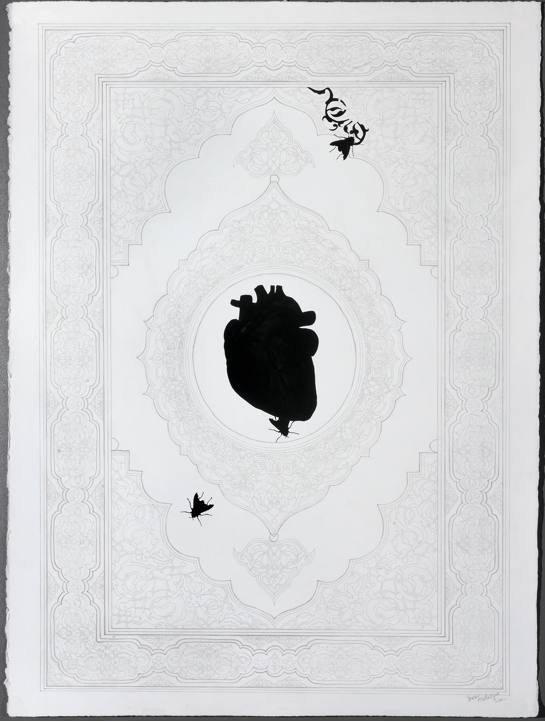
Mudasser’s black heart and moths, enclosed in a pencil-drawn illumination, lies somewhere between irony and devotion. Talpur’s mashq is a simple (yet beautiful) calligraphy exercise that is done with kalam and ink. The work is an endless exercise into deconstructing the meaning of the word itself and a form of devotion, disciplining and meditation. The patterns formed with varying densities of ink, gives the illusion of 3-dimetionality and movement, touching on memory, time and repetition.
Imran Mudassar
Untitled
Pencil and poster paint on paper
2011
Mohammad Ali Talpur
Mashq
Ink on paper
2011

Chagani’s tiny replicas of terracotta bricks, in the form of a wall and a cubical structure, titled Silence and Frozen, dropped Naail’s jaw. Also it was easy for him to interpret what the wall may signify. “Walls are to separate one area from another – to create boundaries – to hold someone back, e.t.c - or may be it is to do with all the good work he did for flood and earthquake victims, he built houses for them, you know!”, said Naail (he couldn't decide whether he needs to read them in the context of Taseer alone or whether he should look at the works for what they are, at times he could do both with the same work, which was pretty impressive). Perhaps it symbolizes the cold of silence and the finality of death, whilst commenting on the politics of labor, both literally and metaphorically.
Noor Ali Chagani
Frozen (left), 16 x 7.7 x 4.6 Inches
Silence (right), 13 x 21.5 x 2.5 Inches (including the base)

Terracotta Bricks, limestone, cement and concrete
2011


Mirza’s diptych, titled In Praise of Red, is literally a pool of blood, juxtaposed with a picture of a funeral, some broken Urdu letters, with both a subdued reference to bodies in the background and a rather direct image of a muscled human skeleton, possibly from a book of anatomy studies. A display of violence embedded in our everyday experience.
Quddus Mirza
In praise of red
72 x 96 Inches
Mix medium on board
2010 
This violence is also the subject of Rashid Rana’s photo-mosaic, which from a distance looks like a Persian rug, titled Red Carpet. The grid, on closer inspection, is actually an assemblage of images of slaughtered animals. This analogy adds an irony to the otherwise uninfluential imagery of slaughtering of humans that we see repetitively on television and have grown immune to. It is only when one steps back from those small images which are knitted together in the narrative that one can see, what Henry James calls, “the figure in the carpet”.
Rashid Rana
Red Carpet 1 (above)
detail (below)
95 x 135 Inches
C-print + Diasec
Edition of 5
2007 

Khan’s installation is perhaps the only work made particulary for the show. White mesh, white cotton drapes, threads and dust, titled Going Home, is a reminder that “Dust thou art and unto dust shalt thou return”.
Saba Khan
Going Home
72 x 48 x 84 Inches
Nylon mesh, cotton thread and dust
2012


Thursday, January 5, 2012

LOC (Line of Control):


The story of the subcontinent’s Partition, is a subject commonly shared, across disciplines, by many artists, writers, film-makers, journalists and historians on both sides of the crooked line. The accounts of this imposed geographic division, after more than sixty years, still continues to hold a sense of immediacy. This very split that triggered sectarian hatred and bloodletting, causing profound physical, social and emotional scars, is also the subject of Pritika Chowdhry’s ‘Remembering the Crooked Line’ on display at Rohtas 2 art gallery, from January 2nd to 14th

Chowdhry is an Indian artist, curator, scholar, and educator who has lived in the US since 1999 and currently visiting Lahore for research on monuments and historical documents for, possibly, a continuation of her critical investigation of the politics of identity/ nation-building.
What is interesting is that much of this retelling of history of the Partition is done by people situated/schooled in the West, as argued by Dorothy Barenscott, in This is our Holocaust: Question of Partition Trauma. She writes that “the interest in witnessing, memory, trauma, subjectivity and history has come to characterize a new direction in Partition historiography, which has a direct and theoretically informed connection to the Holocaust; a distinctly western preoccupation”. How their diasporic status informs and shapes their work, on this subject, is worth investigating.
In any case, at the core of the subject is the analysis of storytelling and storymaking. Storytelling for survival perhaps, just like Scheherazade of Arabian Nights, to either prevent or allow the existence of a no man’s land, an ambiguous site, in-betweeness, a place of regenerative promise.
In an attempt to articulate this understanding of borders, Chowdhry’s work is an unavoidable situation of constructing, breaking down, reconstructing, telling and retelling the imaginary relationship between tangible and intangible or fact and fiction. She writes: “I think of maps as the skin of the nation. By extracting real and fictionalized cartographic fragments of the border lines of each of the above-mentioned countries (India, Palestine, Ireland, and Cyprus - former British colonies), and grafting them onto garments, board games, and kites, I attempt to give material form to the skin of the nation. While the physical human body is made elusive in this project, its absence is alluded to by several corporeal references. In each of these objects, the maps have been manifested on materials which have been manipulated to feel like skin. This installation is comprised of five parts. The first four consist of sculptural renditions of playing Ring-a-ring-a- roses, flying kites, playing a game of Parcheesi, and playing a game of chess. Each of these activities is played in the above-mentioned countries as per local customs. In this project, these games are cross-cultural motifs that highlight between these nations, and allow the viewer to engage with large transnational histories from a personal and individual location”. 
Pritika Chowdhry
Ring-a-Ring-a-Roses, part I
Tassar and raw silk, goddess hair, hand embroidered, wax.
Set of six vests (kurtis).
2009
Pritika Chowhdry
The Shadow Lines
Handmade flax and abaca paper, pig and cow guts, surgical suture, thread, wax, walnut ink.
Set of twelve kites.
2009
Lines of Control
Digital prints on Indian dupioni silk, conte crayons, marker pens, wood.
2009


Using a variety of mediums (such as; raw silk, hair, Khadi cotton, wire, wax, embroidery, surgical suture, thread, e.t.c) Chowdhry has utilized these objects (chess board, Parcheesi board, kites, bodices) for their objective reality, as a substitute for human presence and for an interactive/physical engagement with the viewer, but I don’t know if they are anything more than surfaces for markmaking. Perhaps the tortured/burnt/sutured skins could have been sealed away as flat surfaces, or perhaps they work better as suspended/displaced objects, viewed against the backdrop of human bodies strolling in the gallery. The game of chess is perhaps too direct or rather illustrative or may be it helps elicits a direct response. Perhaps it only presents the viewer with a range of contemporary issues with mapmaking or maybe there is a fine balance between analyzing both the psychic spaces (fact and fiction) objectively and asking for a redefinition of these imaginary lines with which we inscribe and divide. Or perhaps it’s a psychic conflict within the cartographic pursuits itself.


Sunday, December 11, 2011

Mark-Making


Using Faiz Ahmed Faiz’s verses for the title of a show or the art works is a popular trend these days, especially when 2011 is the year of Faiz’s 100th birthday. Not to say that it’s a bad thing to do, but with such actions comes huge responsibilities. And the question is; is Faiz only being used as an advert, a symbol or is it an honest expression of solidarity?
“Jo dil pe guzarti hey raqam kerte rahein gay”
is the title of Khalil Chishti’s solo exhibition at Rohtas 2, Lahore, from 9th to 17th December, 2011. The burnt marks on paper, enclosed in frames that are made of metal pipes, welded together, hanging above eye level, are to be viewed by climbing on a step stool, through a magnifying glass chained to each frame. Next to each work, except two, is a sheet of paper requesting the viewer to ‘please suggest a title for this work’.


Khalil Chishti, Please suggest title for this work IX, welding spark drawing on acid free paper, 2011
Please suggest title for this work III, welding spark drawing on acid free paper, 2011
In the absence of the titles and any artist statement accompanying the works, the questions that this work raises are so typical yet so crucial, that in answering them, I shall not only help myself understand Chishti’s work but also explore some of the issues that are the core of contemporary art, concerning the problem of ‘painting’ and ‘drawing’. Is mark-making a sort of drawing? Are not these pictures really abstract paintings with no titles? Do titles of abstract paintings really matter? Does giving a title deny it something because of the resulting emphasis on subject matter? Or is it to exploit the technical aspects of painting? What Do they Represent, when titles do not say and pictures do not show(referring to Michael Corris’s book)? Is it a retreat from names, identification, and language itself? What is the function of titles that are given by the viewer? Or why they might be regarded as important? What does the task of looking through the magnifying glass and giving a title, do for the viewer? Is it to make the viewer an active participant only? Or does it reveal something that one might have overlooked without the given task? Does it challenge the conventional associations art historians like to construct through titles, like the surrealists who use to hold sessions in which they suggested titles to each other? Or are titles considered confusing diversions, like the abstract-expressionist believed? Does it help generate an inexhaustible flux of random images for the viewer? Is it a comment on representational attributes of art? Is titling artwork part of the explanatory problem that faces artists and historians alike or is it part of its solution? One explanation might be (note: read in an extremely exaggerated manner :p) The meaning, the message of these paintings lies inside the viewer. Instead of trying to look for something in the image, let the image seep deep inside of you and listen to your inner voice. Let the universe share its meaning with you, that has been yearning to be heard. Hear a message intended just for you. Apologies for being impolite, but on a serious note, I do agree that its not about trying to find something recognizable, though many may do so as their way of giving the painting meaning, ultimately, it is about looking at the images in a relaxed way, devoid of pressure. But the significance of this truth depends on the way in which this explanatory task is registered in the work, and my primary concern is the way in which it remains unclear as to its function.


Please suggest title for this work I, welding spark drawing on acid free paper, 2011
Can such abstract or automatic drawings possibly have the same meaning and affect today that it did in the past? What do they express? Are they automatic drawings? Or are the frames and markings only a by-product of a welding activity? As the description of the mediums reads, ‘welding spark drawing on acid free archival paper’? The possibilities are endless. These sheets of paper attacked with a vigorous gestural expressionism are freed from the need of describing through the framework of mark-making. A sort of a script, preserving the smallest and most fleeting traces of the maker’s hand. Also these marks reveal the physical energy used in their making a bit like music, in its use of harmony and orchestration, combining both subconscious and more deliberate marks, a sort of a partnership between; the maker, the welding spark, the metal and the paper, rather automatically. The magnifying glass did help engage me more actively and made me wonder about how to interpret different line qualities from crisp and sharp to soft and diffused, from raised and overlaid to recessed and inlaid, from the burnt edges to the metal emitting from the holes punched in paper and the incidental text on the glass written in reverse. The possibilities are truly endless!
Ek arz-e-tamanna hai so hum karte rahenge

Wednesday, November 16, 2011

FAMILIAR NAMES


Art exhibitions bearing the name of a curator but often lacking a curatorial perspective is a common situation. But the artist-as-curator, especially when his/her work is part of the show is a rather new phenomenon in Pakistani art circle. And such incidents makes one wonder if it is to challenge/critique the art establishments, to explore new ways of seeing, to find ways of introducing/empowering a certain muscled out group or a rather experimental art or for any other number of reasons? Similarly when I heard about Familiar Names displayed at the Drawing room gallery in Lahore, in Novemeber 2011, showing the works of 12 young BNU graduates, curated by Shiblee Munir (one of the artists in the group) I began to wonder about the significance of the title of the show, the choice of the works...e.t.c, only to realize at the end that its pretty random. Curating and organizing exhibitions, even though looks quite impressive on one’s resume, needs to address the characteristics and responsibilities of curators as interpreter, facilitator, catalyst, instigator, e.t.c, more seriously.
If I were to discern some commonality between the works in the show, it would have to be the interplay between conception, construction and representation. This effort to try and balance the conceptual and the material, exploratory and explanatory or individualist and idealist aspects of the work, is only natural for these young artists, whose experience of making and presenting their BFA degree shows, is not so distant. Which is why, despite the widespread diffusion of computer-aided art, most of the works in the show were made from traditional materials and techniques, in a deliberate attempt to exhibit their skills.
Shahzad Ali’s metal rack with glass jars, containing rubber casts of minar-e-Pakistan, titled The showcase, is a very straightforward representation of the country’s troubled identity. Making reference to the pickle jars, it makes one wonder, if the miniature minarets were actually pickled or at least preserved in a similar solution instead of water, it may have made more sense in the context of the meanings attached to the word ‘pickle’, making the irony more prominent, visually. His other work, titled White! Back ground, is an installation of dead doves scattered on the floor of the gallery. My first guess was that these birds are real, but on close encounter they appeared to be made from cotton or some other soft material. These silicon birds are made very realistically, located in a space between the actual and the virtual.
This space in-between real and fictional is also a feature of Pratima Thakali’s surreal painting, titled Little Flyer. Resembling the print media, particularly advertisement, in design aesthetics and color compositions, a simultaneous reality exists within the frame of this large canvas, juxtaposing nonlinear mutidimentional realms of experience across time and space, that appears to be operating through chance, independent of the author’s will, yet also making references to the everyday/familiar world.
Simultaneous realities are also the subject of Haroon Mughal’s photomontages, made by overlapping different images off the street that are paired with silhouettes of a familiar object or another reference to the street, voicing his concerns about the socio-political confusion of the present and the uncertainty of the future.
Shiblee Munir’s minimalist representation of Another Realistic Painting done with black watercolor on a white board is in my humble opinion, a dialogue with the medium primarily, perhaps an attempt to get in touch with one’s rather instinctive/unconscious side through almost automatic drawing. Munir may not need to support his abstract work with more abstract words, like in the artist statement.
Fahad Hameed’s Point Zero and Breeze, is not only an optical illusion but an endurance test. Breeze, with black thin ribbons stretched vertically across a frame, hanging against a white wall is almost impossible to look at, without feeling noxious. Not as a particularly disgusting encounter but as a natural consequence of looking at those black stripes that are continuously moving from right to left and left to right because of the fan installed on the ceiling. Concerning the interaction between illusion and picture plane, between understanding and seeing, existing in the midst of limits and possibilities of making, seeing, looking, experiencing, changing perception and revelation.
Movement is also inherent in Hira Rafi’s paintings. These landscapes, as if experienced while in a car, although painted in acrylics on canvas, note the presence of the camera. A possible impediment for the viewer in actually experiencing this movement is perhaps the scale, I wish that the canvases were much larger than 8 x 10 inches.
Shahzad Hassan Ghazi’s exploration of the mediums is demonstrated in scratching, drawing and painting the cityscapes on rusted tin. Waqas Anees’s Fossils is a similar investigation of materials and process. His bricks, encasing non-recyclable plastic items speaks of outdated (or perhaps not) ideas of technological advancement, industrialization and its affects on environment. Faiza Bashir, Ayesha Yousaf and Salman Hassan’s mixed media works also have a lot of potential that perhaps needs a lot more time to simmer before presenting it for viewing or may be I’m being severely critical and its premature to be making such judgements, most of it is thesis work after all.

Thursday, October 20, 2011

TRUTH ABOUT PERCEPTION:


“...though we cannot know these objects as things in themselves, we must yet be in a position at least to think them as things in themselves; otherwise we should be landed in the absurd conclusion that there can be appearance without anything that appears.”
   Immanuel Kant, Critique of Pure Reason.

Our relationship with both physical and abstract phenomena, the ‘existence of nature’ in contrast with ‘the perception of this existence’, has been a subject of inquiry for philosophers and artists alike. Without going on a wild goose chase regarding such questions, in my humble opinion, beyond perception most concepts do not even matter, that is to say, there is no relationship between objective and subjective reality, since all reality is subjective by definition and vice versa. And that is where the essence of Art lies, as Ayn Rand writes (explaining her philosophy of Objectivism in the context of Art), “as a selective re-creation of reality according to an artist's metaphysical value-judgments". This re-shaping of non-empirical ideas into physical form is the curatorial foundation of SCORE, exhibiting works by Ehsan Ul Haque, Imran Ahmed, Iqra Tanveer and Sajjad Ahmed, at Drawing Room Art Gallery, Lahore, from October 12 – 22, 2011.
In a country like ours, each one of us is so busy wheel-running like laboratory rats, expending so much effort on issues of political instability, shortage of electricity, gas and petrol, extremism, terrorism, e.t.c, that even the Art exhibitions barely get a chance to look beyond the rim of the wheel - such an exhibition then, is a moment of relief. But that does not imply that the work is not political in nature, how can it not be when society itself is the physical aspect of the world we inhabit. 
Ehasan ul Haque, Physical Existence of Belief.

Ehasan ul Haque’s Physical Existence of Belief, a 4’ x 4’, concrete cube, is a kaaba of personal realities or perhaps the monolithic power of the authorities. It defines man's nature and the nature of the world in which he lives, recalling the old axiom, if we truly believe a lie it might as well be the truth for the impact it has. The construction of beliefs that rests in the realm of non-physical is made into a physical object in concrete, a medium that is not simply experienced phenomenologically but is associated with social references, particularly of ruins and construction sites.
Imran Ahmad, Hypothalamus
Naan (flat breads) is the medium and the subject of Imran Ahmad’s Hypothalamus: region of brain controlling hunger, thirst and body temp, addressing the physiological needs for human survival. These 11 or 12 kinds of naans, that are made from different ingredients, instantly bring to my mind the image of a menu card of any restaurant, a list accompanied by their prices and it makes one wonder about needs measured against luxuries. The piece (to me) is a bit nervous or unconvincing, so to speak. This literal translation takes a rather bland approach towards parody, perhaps just a little bit of irony could have made these naans extraordinary instead.
Sajjad Ahmed, Play Field.         Iqra Tanveer, Paradise of Paradox 
 Where as, the formal aspects of Iqra Tanveer and Sajjad Ahmed’s work require experiencing the physicality of these works in person. Ahmed’s Play Field, a digitally manipulated print of a football field, despite being a 2-dimensional image, appears to be a 3-dimensional illusion and creates (if only for an instant) a kind of a doubt/uncertainity about our knowledge about things (our understanding of geometry) and the existential facts of objects. Tanveer on the other hand, addresses the nature of perception, representation, space, materiality and absence through a play of light and dust. Paradise of Paradox, is a darkened space created within the gallery, testing the truth about perception. It is a niche, which omits light from the thin slits on both sides, and beyond that is placed a blower that blows dust into the air every few minutes. This transformation of air and light into physical matter, demands a hypersensitive looking, feeling, listening, smelling and knowing. This creates, if only for a few minutes, a thin film of dust particles with the use of light, that appears so tangible that one is compelled to poke his/her finger, hand or head through it, creating that doubt about seeing, knowing and experiencing. Though the piece is not without its shortcomings, particularly in terms of its carpentry, because of which instead of creating this illusion of a film of dust edge to edge, it was only visible in a small portion, but each one of her audiences had their moment of awe.


Tuesday, October 18, 2011


“the autobiographical enacts the self that it claims has given rise to an ‘I’ and that ‘I’ is neither unified nor stable – it is fragmented, provisional, multiple and continuously in process”. (Interfaces: Women, Autobiography, Image, Performance,pg 9).


i ≠ i is the title of a group show that opened on 14th October, 2011 at Nairang gallery. The exhibition is a product of a 2 week workshop with final year (BFA and MA) students at Beaconhouse National University, conducted by Kathrin Becker, who is a curator and art historian from Berlin. As the title of the show suggests, the 19 artists in this show indulge themselves in authoring, narrating and acting the ‘self’, investigating the subject of embodiment and the embodiment of subjectivity, interrogating the subjective dimension of ‘being’ and examining the dislocation and fragmentation of that ‘being’. Though, autobiographical self-representation has throughout history been the subject of art but this autobiography, while expanding modes of self representation through a process of self-knowledge and self-telling, reveals the conception of the ‘self’ as an imaginary construct, “fragmented, provisional, multiple and continuously in process”.

                   Demonstrating the permeability of the self’s physical and symbolic boundaries, the works in the show, reflect on memory, negotiate the past, engage aspects of gendered selves, lived experiences, popular culture and critique socio-political and cultural constructs/narratives, all of which co-exists in the same space. Mirza Ruknuddin Ahmad's I love Art, is a site of conflicting social definitions and a ground for examining the constructed and mediated roles. Hanifa Alizada, redefines her gendered Afghani (war-torned) identity with a fine balance of humor in Who we are? Rabia Anwar’s Split, in an investigation of similarities and differences between her mother and herself as brides, becomes the articulation of female subjectivity. Zeb Bilal’s I am the ‘Other’, traces the history of hybrid identities exemplified in dresses of the colonizers and the colonized. Similarly Sadaf Chughtai in Three views of Lahore Fort, traces the history of modernity and progress, the final image is a hybrid of old and new Lahore exemplified in the architecture of her Fort. Umair Iqbal’s representation of identity is also associated to a city and culture but to something more tangible, perhaps ‘only’ tangible. Lying somewhere between rebellion and submission, Raiha tul Jannah’s works address issues of her gendered identity, difference and the politics of representation. Among the participants also, are; Sofia Shahi, Shimul Saha, Anees-ur-Rehman, Shumaila Noor, Saima Noor, Ahmed Faizan, Maimoona, Eliza Khosa. It is practically impossible to discuss all the works here, so i shall briefly present some of them, all of which approach the issue of identity from divergent perspectives.
Rabia Anwar, Split (2011),                 Saima Noor, Untitled (2011),
digital print on photographic                 salt prints on paper
paper.
                                                     
Sadaf Chughtai, Three views of Lahore Fort (2011), digital Print (archival ink on cotton paper)


Saleem Abbas’s Identify??? is a short video, in which Abbas, who is easily identifiable because of his long black hair, has used himself as a site and a metaphor for the representation of the self. The screen, split into two, shows Abbas, from the front and back view on either side, combing his long dark hair, wearing a pair of jeans and no shirt. Diminishing the distinction between front and back by covering his face with hair and wearing the pants and the belt inversely, Abbas confuses his audience, even if only for a few seconds, and makes them ponder over the process of identification. 
Komal Naz, Untitled (2011), video, 2:50 min.
Similar in aesthetics, is Komal Naz’s presence in her almost 3 minutes long untitled video. Confined in a close frame is a wooden stool laying on its side that Naz, tries to fit into. While Naz struggles with this seemingly meaningless task, illustrating an existential crisis, one waits for nothing to happen, as if stuck in motion for time immemorial, which could be further highlighted if the video didn’t fade into black every time before restarting, it could easily do without marking the starting and the ending especially when there was no starting and ending and could have worked better in using it as a metaphor for the space which the mind occupies. Nevertheless, this video was one of the most engaging pieces in the show.
Zaib Haider, Untitled (2011), digital prints on photographic paper

Use of family snapshots open reservoirs of memories, but it’s certainly the objects and not the people in those photos that Zaib Haider is after; household details, toys, shoes, bags, e.t.c, fraught with meaning, besieged by domesticity, drained of life as mundane objects, a very important feature of family albums. Haider intends to appropriate, disturb and manipulate images that look simple, naive and sacred, resulting in distortion, disorder and disintegration by highlighting certain details while blurring the others.


Amber Hammad, Hum KEH Thehray Ajnabi (2011), digital Print on canvas (edition 2/3)
Amber Hammad, unlike others is not directly the subject of her work. Her digitally manipulated, Hum keh Thehray Ajnabi is an image made with photographs of bazaars from both Lahore and Delhi. The uncanny resemblance between the sister-cities is further highlighted by baring the image off any cultural references to bodily differences and reducing the people to black silhouettes. Pointing out the similarities more than the differences between the two, Hum keh Thehray Ajnabi while negotiating between self and other is a comment on close familial ties, shared histories, displacement, nostalgia and unfriendly relations, calling into question the true status of seemingly fixed categories of identity and our reliance on socially, politically and culturally assigned identities.

These artists challenging the notions of prescribed identities, however superficially, have at least begun to analyze the reality of their own fiction. Also, its a good drill for people who will be putting together their degree shows in only a few months.

i ≠ i


is the title of a group show that opened on 14th October, 2011 at Nairang gallery. The exhibition is a product of a 2 week workshop with final year (BFA and MA) students at Beaconhouse National University, conducted by Kathrin Becker, who is a curator and art historian from Berlin. As the title of the show suggests, the 19 artists in this show indulge themselves in authoring, narrating and acting the ‘self’, investigating the subject of embodiment and the embodiment of subjectivity, interrogating the subjective dimension of ‘being’ and examining the dislocation and fragmentation of that ‘being’. Though, autobiographical self-representation has throughout history been the subject of art but this autobiography, while expanding modes of self representation through a process of self-knowledge and self-telling, reveals the conception of the ‘self’ as an imaginary construct, “fragmented, provisional, multiple and continuously in process”.

“the autobiographical enacts the self that it claims has given rise to an ‘I’ and that ‘I’ is neither unified nor stable – it is fragmented, provisional, multiple and continuously in process”. (Interfaces: Women, Autobiography, Image, Performance,pg 9).


            Demonstrating the permeability of the self’s physical and symbolic boundaries, the works in the show, reflect on memory, negotiate the past, engage aspects of gendered selves, lived experiences, popular culture and critique socio-political and cultural constructs/narratives, all of which is co-existing in the same space. Mirza Ruknuddi Ahmad’s I love Art, is a site of conflicting social definitions and a ground for examining the constructed and mediated roles. Hanifa Alizada, redefines her gendered Afghani (war-torned) identity with a fine balance of humor in Who we are? Rabia Anwar’s Split, in an investigation of similarities and differences between her mother and herself as brides, becomes the articulation of female subjectivity. Zeb Bilal’s I am the ‘Other’, traces the history of hybrid identities exemplified in dresses of the colonizers and the colonized. Similarly Sadaf Chughtai in Three views of Lahore Fort, traces the history of modernity and progress, the final image is a hybrid of old and new Lahore exemplified in the architecture of her Fort. Umair Iqbal’s representation of identity is also associated to a city and culture but to something more tangible, perhaps ‘only’ tangible. Lying somewhere between rebellion and submission, Raiha tul Jannah’s works address issues of her gendered identity, difference and the politics of representation. Among the participants also, are; Sofia Shahi, Shimul Saha, Anees-ur-Rehman, Shumaila Noor, Saima Noor, Ahmed Faizan, Maimoona, Eliza Khosa. It is practically impossible to discuss all the works here, so i shall briefly present some of them, all of which approach the issue of identity from divergent perspectives.
            Saleem Abbas’s Identify??? is a short video, in which Abbas, who is easily identifiable because of his long black hair, has used himself as a site and a metaphor for the representation of the self. The screen, split into two, shows Abbas, from the front and back view on either side, combing his long dark hair, wearing a pair of jeans and no shirt. Diminishing the distinction between front and back by covering his face with hair and wearing the pants and the belt inversely, Abbas confuses his audience, even if only for a few seconds, and makes them ponder over the process of identification.
                                                                                          Similar in aesthetics, is Komal Naz’s presence in her almost 3 minutes long untitled video. Confined in a close frame is a wooden stool laying on its side that Naz, tries to fit into. While Naz struggles with this seemingly meaningless task, illustrating an existential crisis, one waits for nothing to happen, as if stuck in motion for time immemorial, which could be further highlighted if the video didn’t fade into black every time before restarting, it could easily do without marking the starting and the ending especially when there was no starting and ending and could have worked better in using it as a metaphor for the space which the mind occupies. Nevertheless, this video was one of the most engaging pieces in the show.
                                                                                          Use of family snapshots open reservoirs of memories, but it’s certainly the objects and not the people in those photos that Zaib Haider is after; household details, toys, shoes, bags, e.t.c, fraught with meaning, besieged by domesticity, drained of life as mundane objects, a very important feature of family albums. Haider intends to appropriate, disturb and manipulate images that look simple, naive and sacred, resulting in distortion, disorder and disintegration by highlighting certain details while blurring the others.
            Amber Hammad, unlike others is not directly the subject of her work. Her digitally manipulated, Hum keh Thehray Ajnabi is an image made with photographs of bazaars from both Lahore and Delhi. The uncanny resemblance between the sister-cities is further highlighted by baring the image off any cultural references to bodily differences and reducing the people to black silhouettes. Pointing out the similarities more than the differences between the two, Hum keh Thehray Ajnabi while negotiating between self and other is a comment on close familial ties, shared histories, displacement, nostalgia and unfriendly relations, calling into question the true status of seemingly fixed categories of identity and our reliance on socially, politically and culturally assigned identities.
            These artists challenging the notions of prescribed identities, however superficially, have at least begun to analyze the reality of their own fiction. Also, its a good drill for people who will be putting together their degree shows in only a few months.